



Why Remote Reading Now Belongs at the Center of Enterprise Imaging
How workforce shortages, volume volatility, and round-the-clock subspecialty demand are pushing radiology groups to rebuild their operations around remote reading — and what infrastructure makes it actually work
Introduction
Not long ago, remote reading was treated as a fallback: a way to keep studies moving during a snowstorm, a staffing gap, or a pandemic lockdown. That framing no longer holds. For enterprise imaging leaders in 2026, remote reading isn't the exception to the workflow — it is the workflow. Radiologists are distributed across time zones and subspecialties by design, not by accident, and the organizations that treat remote reading as a first-class operational strategy are the ones keeping turnaround times down and coverage gaps closed.
This shift didn't happen because it was trendy. It happened because three pressures converged at once — and none of them are temporary.
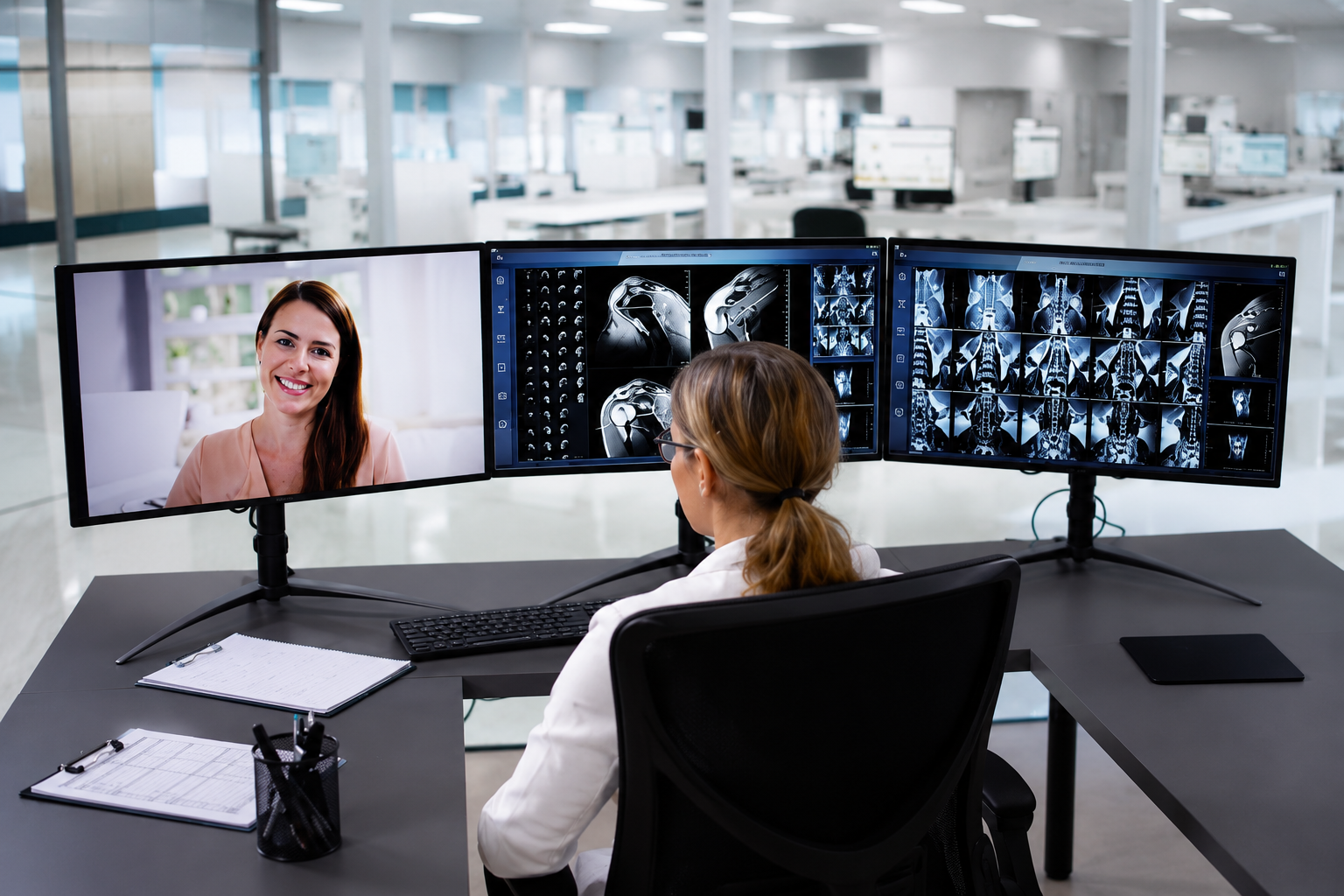
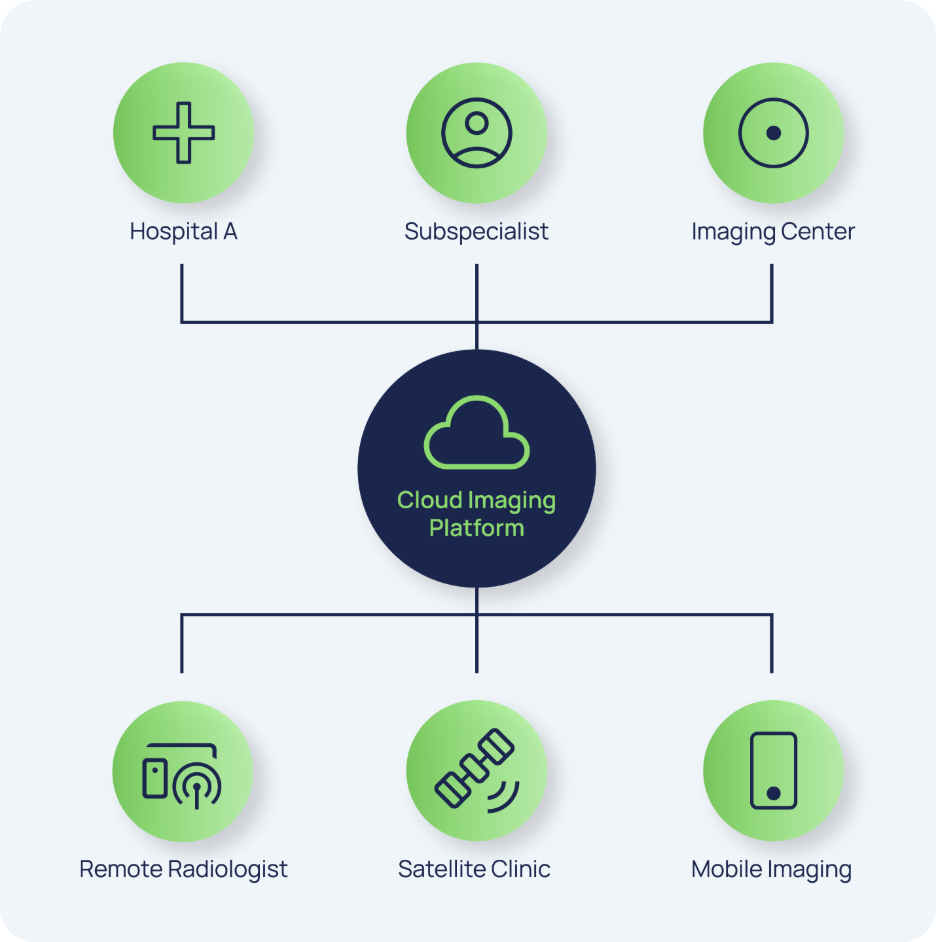
Enterprise imaging today: radiologists reading from anywhere, connected to every site through a cloud platform.
The Workforce Shortage Isn't Closing — It's Stabilizing at a Deficit
The radiologist shortage has moved from "looming" to structural. A December 2025 federal workforce analysis projected a national shortfall of roughly 141,000 full-time physicians by 2028, with radiology positioned only slightly better than the physician workforce overall, according to the American College of Radiology's coverage of a Health Resources and Services Administration (HRSA) report. Longer-range modeling from the Neiman Health Policy Institute reinforces the same conclusion: the workforce is not expected to shrink further, but it is not expected to meaningfully improve either, unless attrition trends reverse or residency capacity expands.
A few figures make the shape of the problem concrete:
- Attrition has more than doubled. U.S. radiologist attrition rates climbed from 1.1% to 2.5% annually between 2014 and 2022, with a sharp acceleration during the pandemic years, per a 2025 Neiman HPI study conducted with Jay R. Parikh, MD, FACR.
- The workforce is aging out. Roughly 32% of practicing U.S. radiologists are now 55 or older, with about 15% at 66 or beyond, according to an AJR expert panel narrative review — a retirement wave that training pipelines aren't built to absorb.
- Open positions are piling up. ACR Career Center listings grew from roughly 611 posted radiologist positions in 2010 to more than 14,000 across 2022, with the pace accelerating further in 2023 and 2024.
- Access is regionally uneven. National averages mask the real story: some states have as few as 9 radiologists per 100,000 residents, well under the national rate, leaving rural and underserved markets structurally short-staffed.
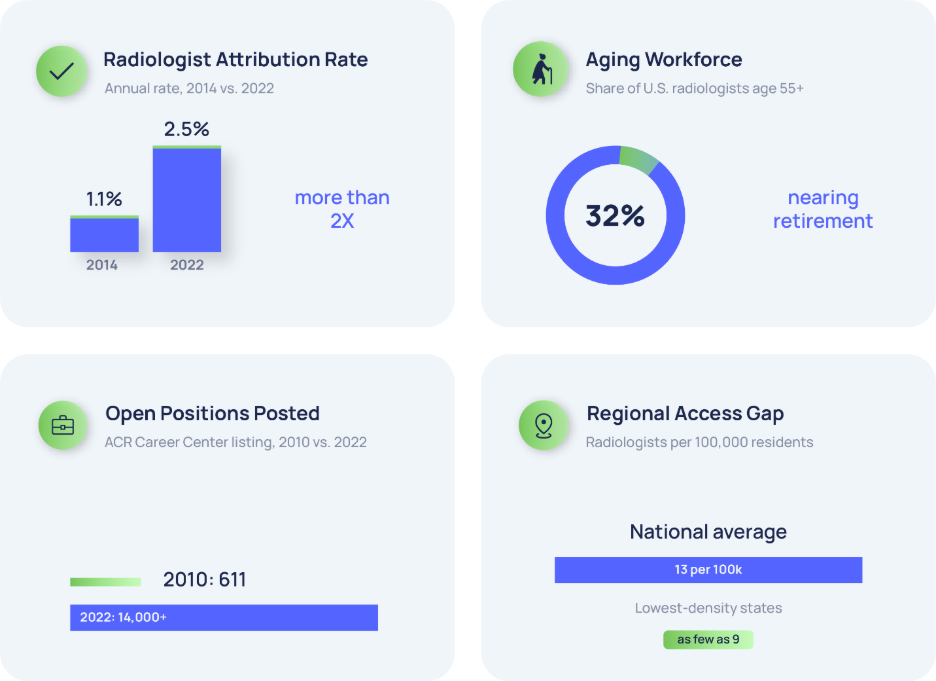
Figure 1: Four indicators of the widening radiologist workforce gap.
None of this resolves with hiring alone — funded residency slots have been effectively capped since 1997, and expanding them requires either new federal funding or self-funded positions that most health systems can't easily absorb. Remote reading is one of the only levers organizations can pull today that doesn't depend on Congress or GME funding cycles: it lets a fixed supply of radiologists cover a wider and more flexible footprint.
Imaging Volume Doesn't Move in a Straight Line — And Neither Should Coverage
While the supply of radiologists is essentially flat, demand keeps climbing. Medicare imaging utilization has risen roughly 13% per beneficiary as measured in relative value units, even as reimbursement per unit has been repeatedly cut to preserve budget neutrality, per ACR Bulletin reporting on Neiman HPI research. Layer in an aging population — with about 20% of Americans now on Medicare, up from 14% a decade earlier — and imaging volume growth becomes structural rather than cyclical.
The problem for enterprise imaging leaders isn't just that volumes are rising. It's that they're uneven: overnight ED studies spike unpredictably, a single hospital's mammography volume can swing month to month, and a multi-site health system rarely has matched supply and demand at every location simultaneously. Static, site-locked staffing models can't flex to absorb that volatility. A distributed remote-reading model can — routing studies dynamically to whichever qualified radiologist has capacity, regardless of which building they're sitting in.
This is precisely the operational problem that platforms like RamSoft's OmegaAI® and PowerServer® are built to solve: instead of static worklists tied to a single site, a Universal Worklist aggregates and prioritizes studies across every location in real time, so volume spikes at one facility can be absorbed by available capacity anywhere in the network.
24/7 Subspecialty Coverage Is Now a Baseline Expectation, Not a Premium Service
Patients and referring physicians increasingly expect subspecialty-level reads — neuroradiology, musculoskeletal, breast imaging, pediatric — regardless of when a study is captured or which facility performed it. Very few hospitals, especially outside major metros, can staff every subspecialty on-site around the clock. Remote reading is what makes true 24/7 subspecialty coverage achievable without requiring every site to hire redundant staff for every shift.
There's also a workforce-retention dimension here. Academic radiology departments have found that allowing radiologists to read remotely even one or two days a week improves morale with no measurable drop in the value delivered to patients or referring physicians. Surveys of practices that adopted internal teleradiology during and after the pandemic found that most saw decreased stress and stable or improved turnaround times, and more than half planned to keep some form of remote workflow permanently. In a labor market this tight, the ability to offer flexible, remote-friendly work isn't just an operational nicety — it's a retention strategy that directly affects whether a practice can keep the radiologists it already has.
Remote Reading Only Works If the Infrastructure Behind It Does
Here's the part that gets skipped in most strategy conversations: remote reading isn't just a policy decision ("radiologists may work from home"). It's an infrastructure decision. A radiologist reading from a home office, a satellite office, or another country needs the same speed, image fidelity, and workflow continuity as someone sitting in the hospital's reading room — every time, with zero tolerance for lag on a STAT stroke study.
This is where a lot of remote reading programs quietly fail. VPN-tunneled access to an on-premise PACS is slow because throughput depends on the facility's own internet connection and the overhead of encrypting every packet, and it's inflexible because it only works from locations where a VPN tunnel has already been configured. Scaling that model across a distributed radiologist workforce means provisioning, securing, and troubleshooting VPN access for every single reader — a cost and support burden that grows linearly with headcount.
This is precisely the gap RamSoft was built to close.
How RamSoft's Platform Is Purpose-Built for Distributed Reading
RamSoft designs its imaging platforms — OmegaAI® (cloud-native RIS/PACS/VNA), PowerServer® (cloud-based PACS), Gateway™ (DICOM router), and Blume® (patient portal) — specifically around the realities of a distributed, multi-site radiologist workforce rather than treating remote access as an add-on to an on-premise system.
Cloud-native access, no VPN required
Because OmegaAI is cloud-native rather than tunneled through VPN, radiologists get secure, diagnostic-quality access from any location without the latency, cost, and administrative overhead of managing VPN infrastructure for a growing remote workforce.
Studies load before the radiologist even asks
OmegaAI's Progressive Loading and pre-fetching/local caching technology loads studies — and prior studies — in advance, so radiologists can begin interpreting immediately rather than waiting for a full download, even over a slower home connection.
One worklist, regardless of how many sites or clients
For radiologists reading across multiple facilities or multiple client contracts, RamSoft's Universal Worklist consolidates every study into a single, prioritized queue, with configurable alerts that flag STAT and critical-finding cases automatically.
Built-in collaboration for a workforce that never shares a physical room
Automated alerts tied to critical findings or study status, group chat, and screen sharing let radiologists, technologists, and referring physicians coordinate in real time — recreating the informal "can you take a look at this" hallway consult in a fully remote environment.
Uptime and disaster resilience that a distributed model depends on
RamSoft's platforms run on Microsoft Azure with built-in disaster recovery and a guaranteed uptime target, and are HIPAA, SOC 2 Type II, and ISO 13485 certified. In one documented case, a teleradiology group used RamSoft's Gateway DICOM Router to restore imaging routing within hours after a natural disaster — the kind of resilience a distributed reading network can't operate without.
Pricing that scales with volume, not with headcount
RamSoft's per-study pricing model means adding new radiologists, facilities, or modalities to a growing remote network doesn't come with per-seat licensing penalties — a meaningful difference for organizations trying to scale subspecialty coverage without scaling costs proportionally.
Independent industry comparisons of 2026 teleradiology platforms consistently place RamSoft among the leading cloud PACS/RIS options built specifically for distributed, multi-site radiology operations, citing its AI-driven prioritization, zero-footprint viewer, and cost-effective scaling as differentiators for teleradiology groups.
Section 5: What This Means for Enterprise Imaging Leaders
Put the three forces together — a workforce that isn't growing, demand that keeps climbing unevenly, and an expectation of round-the-clock subspecialty coverage — and the strategic conclusion is hard to avoid: remote reading capability is no longer a nice-to-have layered on top of enterprise imaging strategy. It is the strategy for staying staffed, meeting turnaround targets, and retaining the radiologists an organization already has.
The organizations that will handle this well aren't necessarily the ones with the most radiologists. They're the ones whose imaging infrastructure can route any study to any qualified reader, anywhere, without the reader or the patient ever noticing the difference. That's the operational bar RamSoft's platform is built to meet.
Sources & Further Resources
- American College of Radiology (ACR) Bulletin — The Radiologist Shortage: A Workforce Update from HPI (Feb. 2026)
- American College of Radiology (ACR) Bulletin — Radiology Workforce Shortage and Growing Demand
- American College of Radiology (ACR) Bulletin — How Will We Solve Our Radiology Workforce Shortage?
- Harvey L. Neiman Health Policy Institute — New Studies Shed Light on the Future Radiologist Workforce Shortage
- American Journal of Roentgenology (AJR) — The U.S. Radiologist Workforce: Expert Panel Narrative Review
- HealthManagement.org — Strategies to Mitigate Radiology Workforce Shortage
- npj Health Systems — AI Solutions to the Radiology Workforce Shortage
- RamSoft — Teleradiology Platform Overview
- RamSoft — OmegaAI: Cloud-Native, Zero-Footprint RIS/PACS/VNA
- RamSoft — Overseeing a Teleradiology Group
- RamSoft — Remote Radiology: Can Radiologists Work from Home?
- RamSoft — Teleradiology PACS: 4 Ways to Optimize Your Setup
Interested in seeing how RamSoft's OmegaAI and PowerServer platforms could support your organization's remote reading strategy? Book a personalized demo to explore a workflow shaped around your team and your coverage challenges.