



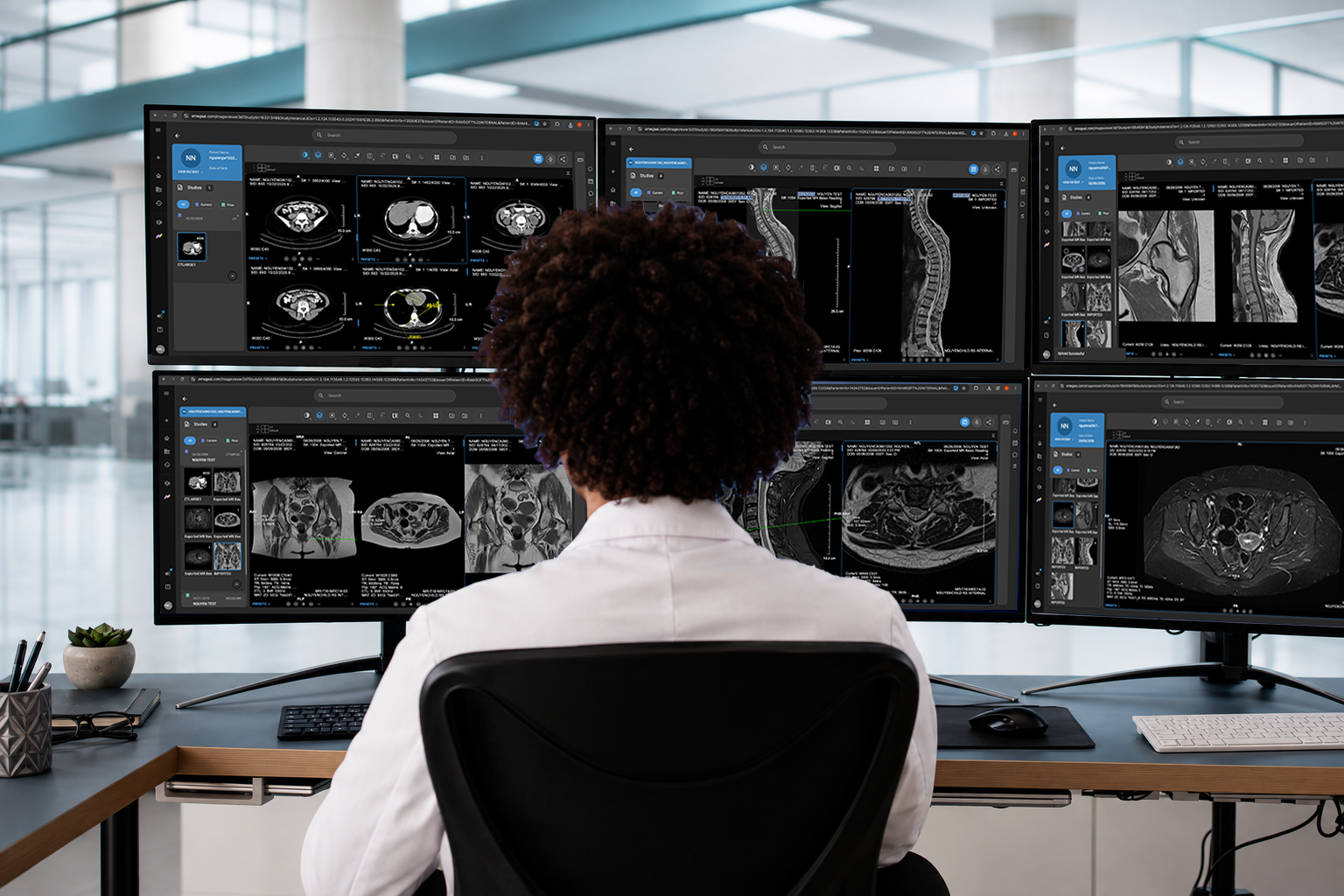
Radiology has more medical imaging AI on the market than any other specialty, and most of that imaging artificial intelligence still isn't moving the needle. According to independent research on U.S. radiology AI adoption, only 19% of practices piloting or deploying AI imaging tools in 2025 reported high success, and separate estimates put overall radiologist AI use at under half. The algorithms aren't the problem. The wiring underneath them, healthcare interoperability, is.
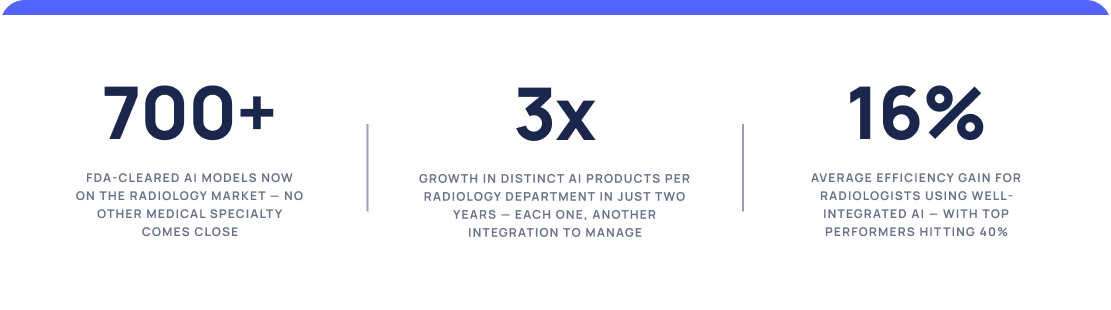
Card 1 Source: FDA AI/ML-Enabled Medical Devices List
Card 2 Source: van Leeuwen et al., Eur Radiol 2024;34:348–354
Card 3 Source: JAMA Network Open, 2025 (Northwestern Medicine)
Every new AI tool inherits an old protocol problem
Any AI tool added to an imaging department needs the same three things: data in, context about where that data came from, and a place for its output to land where a radiologist or system will actually act on it. That handoff runs through decades of infrastructure decisions: HL7 2.x messaging built for one-to-one interfaces, FHIR (Fast Healthcare Interoperability Resources) built for modern, many-to-many exchange, and DICOM underneath both, the backbone of DICOM interoperability across every imaging modality.
This isn't an abstract debate. In January 2026, the Office of the National Coordinator for Health IT opened a formal request for input on diagnostic imaging interoperability standards, signaling that data exchange in radiology, and the broader interoperability of electronic health records, has become a policy priority, not just an IT preference. Independent research on hospital AI adoption backs this up directly: surveyed radiology departments consistently name cost and IT integration, including FHIR integration, not clinical accuracy, as the biggest obstacles to putting AI in medical imaging into daily use.
For imaging leaders, that translates into concrete, dollars-and-minutes questions. Which protocol, HL7 or FHIR, governs which connection. Whether a per-link gateway fee scales with growth or against it. Whether an enterprise buyer's HL7 FHIR requirement is a checkbox or a real capability. None of this is visible in a demo. All of it determines whether an AI diagnostic imaging investment pays back in months or sits unused.
Stacking point solutions doesn't fix a wiring problem
The instinct across imaging operations has been to add: another DICOM AI model for triage, another for reporting, another for scheduling. Each one solves a narrow task well. None of them talk to each other by default, and each new connection becomes another integration project, another protocol to reconcile, another point of failure between intake and a signed report.
That's the operational barrier hiding behind “adoption lag” statistics. It isn't that radiologists distrust AI in principle. It's that disconnected tools compound manual work instead of removing it, routing cases by hand between systems that were never designed to share a workflow, the exact failure point behind stalled AI in radiology workflow initiatives industry-wide.
Orchestration closes the gap between algorithms and outcomes
Fixing this means treating healthcare interoperability as infrastructure, not an afterthought bolted on per integration. That calls for a radiology AI platform, an AI orchestration platform layer that sits across intake, acquisition, interpretation, and workflow: one that speaks HL7 where legacy systems require it and FHIR where modern exchange demands it, enabling true radiology workflow orchestration so every AI tool in the stack shares the same operational context instead of running in its own silo.
Done well, this shows up as measurable change, not a vague promise of innovation:
- Fewer manual routing steps between systems that don't natively talk to each other
- Faster case assignment and reporting turnaround across multi-site operations
- AI models that reach production use instead of stalling in pilot
- One integration layer instead of a new project for every new tool
That's the difference between owning a collection of AI point solutions and running AI orchestration for imaging operations: the same outcome imaging leaders are already being asked to justify to their boards — faster turnaround, higher throughput, and AI that's actually in production, not parked in a pilot folder.
Cloud-native platforms built with FHIR-native architecture, such as OmegaAI®,* are designed specifically to close this gap, giving enterprise and multi-site imaging organizations one orchestration layer instead of a growing stack of disconnected integrations.
*RamSoft®’s cloud-based PACS platform, PowerServer®, doesn't natively speak FHIR, and it doesn't have to. Our integration layer transforms PowerServer data into FHIR R4 and delivers it through OmegaAI's API, enabling modern interoperability without replacing existing systems.
Ready to see what orchestration looks like in your workflow?
See how AI orchestration turns disconnected imaging tools into measurable turnaround-time gains.
See Orchestration in Action →